


A gentleman can live through anything, if he only keeps his self-respect.
— George Santayana, The Last Puritan (1935)◊The look of a gentleman is an expression of an internal quietude.
— Charles Baudelaire, The Painter of Modern Life (1863)
To tell a story of my identity, I must look at the different tempos of my life. You are invited to read this piece through its three progressive movements:
Movement I: Caps
Movement II: Code
Movement III: Cadence
It is in very bad taste, even for a frolic, for a young woman to assume boys’ clothes, or get herself up in any way that will tend to make herself look masculine. (Practical Etiquette, 1899, as cited in Smith & Greig, 2003, p. 16)
Movement I: Caps
(Allegro Moderato: the emerging disciplines of wardrobe mindfulness, protection, and self-possession)
There is a distinct taxonomy to the word gentleman, one often weighed down by the dust of old country clubs and predictable genealogies. But I have never built my identity on predictability. Instead, I find my reflection in the sharp, clean lines of a tailored tuxedo and the smoky, defiant posture of Marlene Dietrich. When she famously muttered, “I am, at heart, a gentleman,” she was rewriting the rules of elegance.
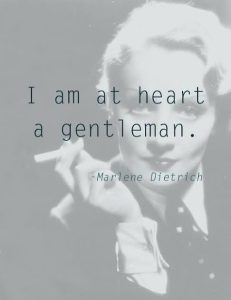
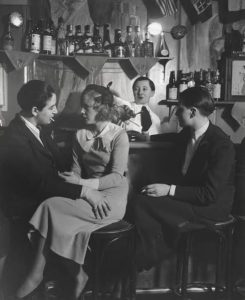
As a person navigating the modern world, I find my lineage not in the House of Lords, but in the subversive glamour of 1920s Paris—among the sapphic icons who frequented Le Monocle (Messy Nessy, 2017), donning tuxedos and slicked-back hair to claim their own definition of power.
In the 1930s and 1940s, Dietrich and Katharine Hepburn made tailored trousers chic. But long before I knew those names, I knew the pull of the clothes. Growing up in the small town of Wapakoneta, Ohio, in the 1960s, I was a tomboy, exploring a world where society’s understanding of gender was far less nuanced than it is now.
As soon as I finished my household chores, I would race out to the Auglaize riverbank at the Hamilton Road Bridge, getting my shoes muddy and caking dirt under my fingernails as I dug up wild carrots and onions to chew. I loved the unvarnished textures of that world, but I also loved hanging out in the basement at my father’s workbench, intoxicated by the smells of motorboat gasoline, freshwater fish, sawed wood, leather work gloves, old tools, and shoe polish.
On other days, I would sneak into my parents’ room, retreat into the closet, and put on my father’s clothes. His massive button-down shirts hung all the way down to my shins, and his ties to my thighs. When he discovered me in his oversized apparel, he didn’t scold my intrusions. Instead, he just chuckled and told my mother, “It’s all right; she’s just playing.”
From that permission, a structured lesson sprouted. He taught me how to tie a necktie. He also taught me how to untie one. By reversing the knot step-by-step, rather than pulling the narrow tail end straight through, he showed me how to protect the lining and the fabric. I practiced those steps with a pressed pucker and eyes pinned to the task.
But the deepest lessons arrived through silent observation. I absorbed the way he meticulously cared for his accessories. At the end of the day, I studied him as he gently brushed the nap of his wool felt hat with a soft-bristle brush, careful to guard the feathers in the hatband. I watched how he hung his tie on a wooden rack on the closet wall, where gravity relaxed wrinkles out of the fabric.
His masculine valet box was a wooden treasury where he kept his silver tie clips and heavy cufflinks in perfect alignment. On the lid, in the smooth scoops carved into the wood, his wallet, keys, and rubber Quikoin purse settled into place. To watch him return each item to its exact coordinates was my introduction to a ritual of maintenance. By honoring each thing in its place, he cared for what carried him—a standard of discipline that became my own way of moving through the world.
In charting his movements, I learned other holy rituals of maintenance: how to shine leather wingtips, clean the mud from heavy hunting boots, and oil and organize the generations of steel tools on his workbench. There was an unspoken gentleman’s code emerging from his basement sanctuary—a philosophy of preparedness, structure, respect, and deep care. As a little girl, I practiced that code in how I packed my school satchel, shined my marbles, and scrubbed my pocket rocks.
My father even taught me how to use his tools to service my little red tricycle. He came home one day to find I had taken much of it apart, its rear step-deck, front fender, chrome handlebars, and rubber tires laid out on the cement carport. The sharp scent of 3-In-One tool oil and sunbaked rubber hung in the midday heat. Inclined to scold me then for leaving things in disarray, he softened when he learned I was merely taking a break to enjoy my mother’s grilled cheese sandwich and tomato soup. He was indeed impressed when I put my tricycle back together and wiped his tools clean.
With those holy rituals rooted in my mind, having outgrown that tricycle, I would stand in front of the mirror in my gentleman’s ensemble, slip a tie clip on, slide a clean handkerchief into a pocket that didn’t have a rock in it, and blissfully sing along to Andy Williams, Nat King Cole, and Perry Como records. I wasn’t imitating a man’s gestures or replicating a masculine stance. I was a young girl being introduced to a lifelong standard of comfort and discipline. I was adopting a code.
On a crisp, autumn afternoon when I was thirteen, a single moment in the kitchen began a conversation to last a lifetime. I came home from school to find my mother standing at the stove, stirring a pot of homemade vegetable soup. I straddled up beside her, the weight of a socially difficult day at school pressing hard in my throat, and whispered, “Mom, I’m different.”
She caught her breath, letting it out in a long sigh. Without a word, she set down the wooden spoon, wiped her hands on her apron, and turned to look at me. “Follow me,” she said. I followed her into the den—her sanctuary of poetry books, family heirlooms, photo albums, and crossword puzzles. Reaching up to a high shelf, she retrieved a book and held it out to me. “Here, read this. You’ll like Jo.”

That copy of Little Women was a vital threshold. My mother offered no conversation, no questions about what my words meant or what I felt; instead, she reinforced her own code of not speaking openly of hard or personal things. But she gave me a lifeline of literature. In the tomboy Jo March, she handed me a tool—the first mirror of a woman defying the rigid conventions of her time, giving me the company, kinship, and language I needed to accept myself. It was the beginning of an intentional, literary education.
She introduced me to the sovereign and subversive poet Emily Dickinson and the dapper and audacious poet Edna St. Vincent Millay. She shared with me the expansive freedom of Shakespeare’s As You Like It, painting the picture of Rosalind—the woman who puts on the architecture of a man’s attire, leaves the court behind, and runs off into the wild green spaces of the Forest of Arden with her “sweet cousin” Celia.

Years later, my mother would pass down to me her own collection of Shakespeare’s plays plus her 1919 copy of the Eleanor Fortesque Brickdale’s Golden Book of Famous Women. Its velvety color illustration of those two free-thinking companions crossing a rushing stream was a testament to what she knew of me. It stood, too, as a validation of the person I was still becoming.

Women, 1919.
Armed with that literary validation, my organic gravitation toward menswear only solidified as I grew. In my small town, we did not have a lot of options for clothes shopping. By my later teen years, my mother would take us to “the mall” in Lima, almost 20 miles away, where she and my sister loved to browse the women’s section of every department store and boutique. Nowhere could I find anything remotely fitted to my taste for bloomers, knickers, trousers, and pants.
I felt a constant, silent friction in those spaces. As my mother and sister raced through the department store aisles to reach the womenswear, I found myself lagging behind, caught in the gravitational pull of the menswear section. Moving past the racks, I felt a forbidden curiosity, a desire to actually step into that space, try those tailored garments on, and claim them for myself. But standing on that second threshold, I didn’t yet have the self-possession or the courage to bridge that gap openly.
To tell them I wanted to buy those clothes meant breaking a code of silence we had all agreed to protect. My mother and sister moved on, oblivious to the fact that something earthy and masculine had completely seized my attention, and I let them go. I didn’t speak of it.
While my sister was drawn to the commercial promise of bright colors and pastels, my mind translated the menswear shadows through the lens of the books and cinema pages I had studied. My only references for women in this practical attire were the old photos of women in men’s suits inside my mother’s coffee-table books about the history of American cinema. I found my place inside those heavy pages.
Looking at the non-color images of the silver screen, I developed an affinity for a different landscape—one built on light, shadow, and structure. Because I could not know the true hue of the wool jackets or the silk ties, my mind translated those deep, velvety shadows into a kinship with the earth. I imagined them as the rich tobacco and burnished umber of my grandfather’s leather jacket and the silt-washed greens of the Auglaize riverbank. To me, masculinity was not loud or bright; it lived in the quiet comfort of that muted vintage color wheel.
Claiming this palette, however, meant breaking a mirror. The sister browsing the pastels beside me was my identical twin, and up until that point, our mother had dressed us alike. The world expects a predictable symmetry from identical twins; it demands that you remain matching halves of a unified portrait. Around the age of twelve or thirteen, I finally asked our mother to stop matching our clothes—a boundary that marked the dawn of my preference for male attire, but also the dawn of serious conflict with my twin.
Navigating the natural upheavals of puberty as an identical twin who felt different in all the ways I wasn’t supposed to be different made me feel isolated. My sister operated in a completely different tempo, guided by a style and code that were entirely her own, while I was quietly searching for my own cadence. Yet the world demanded a mirrored choreography from us. I felt a crushing pressure to keep up and match her, which bred an anxious restlessness in me.
Without the mental health counseling I so clearly needed, that anxiety manifested into odd, alarming behaviors and choices that were distress signals. My parents, older siblings, and teachers did their best, but the pressures of the label identical twins embedded in my mind in damaging ways. It was a tangled landscape for a young person to untangle alone. I was caught between a complicated relationship with my father and the mirror of my sister. It would be several years before I could finally bring my individual self into focus and step away from those pressures.
While I was struggling to untangle my rhythm from twinship choreography, my mother was weaving her own crucial thread into the fabric of my code. She was a woman of bold and bright palettes who sometimes bemoaned the muted, vintage color wheel I preferred, yet she did see me. I was not invisible to her.
Her strength as a mother was to accept and love each of her children as the separate individuals we were. When I asked her to stop dressing my twin sister and me alike, she did not push back; she honored my request and agency. She opened a door that she would never close on me, leaving me free to step through—even when the room on the other side was dark, confusing, and unmapped.
My mother understood intuitively that becoming is hard, lonely work. Having carried her own complicated family history with mental health—and perhaps recognizing the first shadows of the generational melancholy we both shared—she knew I needed help. But my mother’s code was one of compartmentalized endurance.
She made an internal contract to compartmentalize the gales of external forces, lock away personal grievances, and present a composed front to the world through an armor of manners, discipline, and impeccable presentation. Her philosophy was defined by quietism and stoicism—a grace under pressure that never asked to be heard or understood. With that unshakeable internal scaffolding, she anchored herself in the room as a loving presence, ready to usher me along with the materials she had at hand.
After my father died, my mother handed me his pocket knives, handkerchiefs, and wooden hat brushes. With a knowing softness, she said, “You’re the only one who’s going to want these, Cheri.” It was the final, graceful alignment of their dual inheritance.
My preference for a natural, earthy palette remains true to this day, anchored by the physical pieces of my father’s world that I took with me into adulthood. I use the very same brushes he used, and I treasure his collection of pocket knives and handkerchiefs. I carry the meaning of those inherited artifacts, and my mother’s 1938 Buckland High School graduation ring, with me into the world. They are not merely keepsakes, but a living history of ritual, care, and love. They are accessories of my sartorial identity and provide something tangible in my never-ending process of becoming.
Navigating the internal labels that matched those early inclinations became a long, turbulent odyssey. I went from simply feeling different, to having a mild case of gender dysphoria, to not feeling present in my body at all, to the deep isolation and confusion of being a young lesbian in a rigid world.
For a time, I rejected the labels of butch, femme, dyke, diesel dyke, passing butch, and soft butch entirely, even while I donned the “dyke uniform” of jeans, flannel shirts, and short hair. Seeking something that felt both personal and political, I embraced the complex intersection of bisexual lesbian, before later reclaiming lesbian as an identity, and eventually playing with the expansive freedom of the label queer.
Each step was a negotiation of boundaries, a path that led me to a definitive cultural juncture fourteen years ago in a conversation with two younger queer women. I listened to how their generation was reimagining these same identity lines, resisting rigid binaries to find an authentic continuum. I was intrigued and delighted by their creative freedom—one vividly describing herself as a fairy princess mermaid femme.
Then, my two friends looked at me in a duet of charm and interest. “What would you call yourself if you let those old labels go?” they asked. The answer that finally broke through the noise of a lifetime remains unshakeable: I am a dapper gentleman poet.

For years, the structured tailoring that matched that label was an architectural necessity—a chosen, intentional presentation. My standard work attire was heavy, precisely-draped trousers; a crisp cotton button-down shirt; and a textured Harris Tweed blazer of heather blue, moss green, or deep tobacco. In winter, I added an argyle V-neck sweater.
Moving from the high-stakes environment of public education into non-profit leadership, and finally into local government communications, I relied on that crisp structure to maintain calm. Yet, no amount of professional best practices truly prepares you for the most bizarre or hostile encounters with the public.
I remember a jarring, late October day on a work site when a business representative explicitly targeted me in the women’s restroom with demeaning gender-based hate speech, asking intrusive questions, and crudely labeling me a crossdresser. On that day, my anchoring uniform was a pair of dark blue Levi’s, a lightweight zip-up jacket, a crisp button-down shirt, and a checkered bow tie from John Helmer Haberdasher. I did not appreciate the late-Victorian social policing.
That is always the peril of the mannish girl. But the fact that [she is] a woman in body, [while] she tries to be a man in mind, exposes her to the animadversions of the ribald. As she mingles with the world, she feeds a kind of vanity by being mannish. (New York Truth, 1893, as cited in Smith & Greig, 2003, p. 164)
My attire was never a masquerade. I was not mimicking a masculine stride or adopting a fake posture to survive the day. I was executing a code of internal discipline and self-possession through external expression—an authentic standard of conduct that demanded I face down intolerance with poise. It wasn’t a vanity; it was a mindset.
When the landscape shifted to more formal affairs, the “internal quietude” (that Baudelaire referred to) naturally transformed into a statement of symmetry and confidence. Tight-collared button-down shirts, Hollywood-style trousers with vintage braces, dye-tested vintage vests and suit jackets, crisp Stetson Whippet and Porkpie hats, and hard jewelry—cufflinks, collar bars, and pocket watches on chains—became my ultimate, deliberate architecture. This attire anchored my steady countenance, allowing me to greet any passing glance of ignorance with a smile, stand firm in my truth, and simply walk away.
For some [women], wearing pants was a necessity; for others, it was an act of defiance; for still others, it was just fun. (Smith & Greig, 2003, p. 7)
I was not impersonating a man. I was not mocking rigid dress codes and rules of gender behavior. I was not role-playing or disguising myself. I was discovering myself. Educated, employed, unmarried, and living on my own, I claimed my personal liberty through my attire, both for personal expression and for social recreation.
I had grown comfortable in my own skin, fully out and settled as a queer woman who wore an outfit for the joy and elegance of it. Years later, that emotional, dapper peak was beautifully captured in my wedding, where the attire was a celebratory declaration of authentic alignment, not a layer of protection.
Yet, the world often confuses a signature style with a permanent uniform. At my retirement party, standing in my sharp collared shirt, V-neck sweater, and a favorite bow tie, I listened to comments about my signature style. A colleague looked at me with warmth and smiled, “Oh, Cheryl, after you leave here, you won’t be wearing bow ties anymore. You’re going to relax into T-shirts and hiking pants.”
She wasn’t entirely wrong, though the shift was born of a much deeper necessity than she could have known. Soon after, the coordinates of my life shifted violently. Retirement landed, followed closely by the exhausting weight of a stalking case amping up in court yet again, a solitary move to a new home, the deep fractures of a divorce, and the confusing bureaucracy of navigating Medicare.
As pieces of my world felt like they were falling apart, the rigid precision of my old uniform became too heavy to bear. I didn’t need to hold myself together with a perfectly knotted bow tie; I needed a soft place to land. I needed to feel safe.
Yet, as those seasons of my personal and professional life shifted, a crisp, geometric power gracefully gave way to a softer, more spacious tempo. The classic suits and polished leather wingtips are now intentionally reserved for specific, rhythmic moments—the geometry of the ballroom dance floor or an evening at the opera. My daily uniform has settled into a collection of “cotton days,” defined by the loose, architectural comfort of breathable barrel-leg jeans, casual hoodies, T-shirts, and soft shoes.
The intentionality behind my clothing remains untouched. Comfort Colors are the only T-shirts I wear. With a palette of nature-inspired tones, a vintage lived-in look, and subtle variations across each fabric, their muted hues are comforting. Grown on American farms and ring-spun, the soft cotton cradles rest and peace.
I mindfully coordinate my colors for the day, seating a beloved Harris Tweed wool newsboy cap onto my head with the same care I once gave to folding a silk pocket square. The cap itself has become a living story, a textured weight that connects me to the physical world. When I walk down the street and doff my cap, it is a rhythmic, silent dialogue—a greeting of respect and “good day” to those I pass, and a signal of self-respect and gratitude for being alive.
Movement II: Code
(Andante: a standard of conduct defined by heritage, lineage, and ritual)
The code I inherited from my parents ran much deeper than the structured professional uniform I have recently stepped out of. An intuitive current guided my tastes long before I had the language to explain them. For decades, even as I was building my professional persona, I gravitated toward paisley patterns in my shirts and bow ties, pulling the teardrop swells and intricate swirls into my wardrobe simply because they felt correct.
I believe that this preference was not an arbitrary aesthetic choice, but an intuitive echo. It was a piece of identity waiting to be validated, a genetic blueprint traced directly back to my maternal roots in the Renfrewshire district of Paisley, Scotland, where the English name for the pattern originated.
My ancestors living in Paisley in the 18th century were likely to work in the textile and hand-loom weaving industry. They were part of the foundational fabric of Paisley’s commercial boom in the global linen trade. The weavers of Paisley mastered the complex weaving techniques to produce the intricate boteh patterns that originated in ancient Persia. They became so famous for it that Europeans and Americans eventually named the pattern itself after the town (Oliver, 2009).

That ancestral current extends directly into my relationship with real-deal, pre-1960 vintage clothing. To me, pulling on an old jacket isn’t just about styling; it is an act of wearing stories. A few years ago, I was talking with a co-worker about this love for vintage textiles, and she offered a different, beautiful lens—she thinks of it as wearing dreams. She prefers her pieces in mint, unworn condition, speculating on the tragedy of garments saved for special occasions that never quite happened in the lives of their original owners.
But I prefer mine somewhat worn. I want the fabric to carry the soft friction of a life lived, a piece of something special that has stood the test of time and has a good story to tell. There is a poignant communion in reaching into the narrow “change pocket” of a decades-old wool jacket and pulling out a fragment of a stranger’s day: an old theatre ticket, a faded hat check stub, an old train ticket, or a diary page dated 1938.
That year echoes with a strange magic, matching the exact hallmark on my mother’s graduation ring. If I were ever to open a vintage clothing shop to house these enduring histories, I would hang a wooden sign over the door with three simple words: Stories and Dreams.
Caring for such old, resilient garments is no longer just a continuation of that quiet childhood discipline; it is the moment the code reveals itself as an inheritance. The requirement to preserve what has stood the test of time connects me to my ancestors, honoring the same care that once protected my mother’s ring, my father’s textured hats, and the tools they had at hand.
Over time, the external world slowly rose to meet this internal architecture, validating the standard of conduct I had carried since youth. I remember the day John Helmer III, running his family’s multi-generational haberdashery in downtown Portland, stopped asking me who I was shopping for and instead exclaimed, “Welcome back! Good to see you again. Are you looking for anything special today to add to your collection?” My whole face smiled. He had paid attention, and the knowing stuck. In that multi-generational space, the external world recognized and honored the dapper gentleman code my father had passed down to me.
There were larger flashpoints, too, where I chose to lean fully into that heritage, letting different eras and bloodlines weave into one another. On an Alaskan cruise—the summer after my mother passed, and a decade after losing my father—I joined my older sister to celebrate a journey in their honor. While convention dictated delicate cocktail dresses for the formal dining nights, I chose a sharp, uncompromising alternative that served as a bold manifestation of the gentleman’s code: a full tuxedo.
I can still feel the deliberate choreography of putting it on—the pleated wing-collared shirt anchored with cufflinks, a self-tied bow tie, the high-waisted trousers held by a satin cummerbund, and the black tailcoat, all grounded by the sturdy shine of black leather wingtips. In a deliberate salute to my mother’s memory, I stepped outside my usual palette to wear a pink tuxedo shirt, using my mother’s pink-floral handkerchief as a soft pocket square, while carrying my father’s white handkerchief in my inside breast pocket.
Stepping onto the dance floor, carrying both of their spirits in the fabric, I felt elegant. I danced the night away and shared fascinating conversations at the bar with women who confessed they wished they hadn’t let convention choose their comfort either.
Now, a deeper ancestral validation has transformed the atmosphere of my home, creating a sanctuary of distinct, overlapping currents. My relationship with music has always shifted with my internal landscape—the steady, familiar rhythms of jazz and blues filling the space when I am cooking, the light steps of American folk playing when I am sitting still, or the lyrical sweep of pop ballads when I am dancing. For years, I also leaned into Native American songs and chants to hold a close, sacred line to beloved friends on the Pine Ridge Reservation in South Dakota. But with their loss, the map of my sanctuary has changed.
Seeking my own roots, I now find myself drawn into a different tempo. When twilight deepens, I consciously step into the reverberating, traditional cadences of Scottish and Irish folk music. It is a deliberate descent into a creative depth—a safe space to submerge myself in history without losing my footing or my breath. Weaving a terrain where my Scottish Lowlands and Ulster Ireland ancestry can safely step out of the shadows and come home, the music provides a visceral sense of return as I read old histories or dress for folk dances and festivals.
The tempo carries the weight of an ancestral labor. Looking at Keith Henderson’s painting, Women Singing at a Table (Waulking the Cloth), I am reminded of the discipline required to shape a piece of Harris Tweed before it ever becomes a dapper newsboy cap.
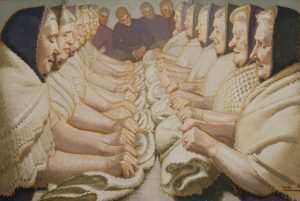
Historically, groups of Scottish women would gather around a wooden bench, rolling up their sleeves to thump, knead, and slam the newly woven wool against the boards. It was monotonous work to shrink, thicken, and soften the coarse fibers—and it was governed by rhythm. To hold their collective strength against the wet, unwieldy cloth, the women sang haunting waulking songs, the tempo of the songs quickening to match the lighter, faster pace of their work. This process permanently locked the deep, earthy dyes into the fabric and compressed the weave into a dense, windproof shield to withstand the harsh, bitter gales of the landscape.
The writing of these very pages has been its own sort of waulking. Just as my ancestors leaned into the heavy, rhythmic friction of cloth to soften it for wear, this slow pooling of words onto paper is the manual labor of my own recovery. Becoming is purposeful, mindful labor that turns an external shield into a birthright.
In the peace of home, I reject the cold glow of screens in favor of the tactile weight of a physical book held firmly in my hands. The evening winds down through a slow, meditative ritual: the pouring of a dram of Ardbeg or Lagavulin. Sitting in the stillness, I breathe in the smoke from the Glencairn glass, letting the heavy peat, ash, and maritime brine linger.
Drinking an Islay Scotch is a deliberate act of translation. As the damp moss and windswept coast flavors unravel on my palate, they ignite a spark of creativity. I set the book aside, take pen and paper in hand, and let the peat and the smoke move onto the page, transforming into the architecture of a poem, a lyric, an essay, or a memory. The creative process, like sipping Scotch neat, is a steady cadence of heritage, lineage, ritual, and recovery—a lifetime of shaping a story and an identity into an enduring weave.

Movement III: Cadence
(Adagio: an internalized philosophy of tenderness, vulnerability, and the right to fledge)
To step into this new horizon of my life is to learn the difference between a fast swing dance and a slow waltz. On the ballroom floor, I still know how to take the lead role, guiding the rhythm with strength, poise, and an expressive precision.
Years ago, that performance began long before my dance partner and I ever reached the floor, and long before she ever became my wife. It was a shared theater of dressing where my fairy princess mermaid femme wore her vibrant dresses and gowns, and I, the dapper gentleman poet, tailored my suit and bow tie to match the bold colors of her choosing. We sacrificed a bit of our separate spaces to mirror one another for the room—and for each other.
While that coordinated costuming belongs to the past, we still share a love for dance. When we step onto the floor again as dance partners, we will continue to create something technically expert and emotionally stirring, pairing the lovely grace of a waltz or the rapid heat of a swing to the perfect song. It is a beauty and joy we will continue to offer each other and the room, even as we show up in our own separate rhythms.
Back home, away from the crowd and the performance, I am learning to honor the restlessness that stirs right where I am. It is a different sort of stirring than the anxious restlessness of my teenage years—the old urgency is gone. This is a solo step, an internal energy that doesn’t demand rapid forward motion or need an audience. It calls instead for a mindful, deliberate presence—a private cadence that allows life to unfold at a more leisurely, sometimes dallying pace, in whatever solitude I choose to claim.
I have spent decades hitting every sharp, exhausting cue of a loud, synchronized ensemble routine in public education, non-profit leadership, and high-profile civic communications. I spent years answering the high-stakes, fast-tempo demands of a public-facing career—navigating the glare of the media and the noise of community crises. Now, I am stepping off that main stage into the wings to find my sway in the rhythm of my own breath and heartbeat. While a willingness of the heart sets the slow course, a capacity of the mind and body is required to anchor there.
This evolution requires a rewriting of what it means to be strong. True gentlemanliness is not a gender, a performance, or a rigid set of rules. It is a commitment to a code of comfort and style that leans toward the masculine but measures its ultimate value by its capacity to stay soft and care for the things and people around you. It is a commitment to tenderness.
Stepping out of the heavy tailoring of the past means letting go of the armor that keeps the world at a distance. It means choosing to remain intentionally vulnerable to the natural transitions of living. I have to ask myself whether I have the internal machinery for this softening. Do I have the spine for the deep mental and emotional labor it demands?
To answer those questions, my mind naturally reaches back to see where that spine was first tested. When the terrain gets rough, I find myself auditing the archive of my own choices, looking for the moments where my simple code of care demanded more than I thought I could give.
Back in the 1980s, when I was a high school English teacher at Montclair High School in Southern California, I taught a basic grammar and literature class each year, to seniors who desperately needed that final credit to graduate. One year, when my usual motivational tactics had stopped working, I made an unusual deal with the students: if every single one of them attended the final workshop and turned in a passing project, I would wear a skirt to school.
My students had frequently expressed curiosity about my teaching wardrobe. I always wore pants, settling into that structured tailoring for a sense of comfort and convenience that allowed me to command the room. It was a puzzle to them that I never wore skirts and dresses; they were curious about a lot of things that I felt would be unsafe and ill-advised to share with them at the time.
But part of my personal code has always been a commitment to modeling the very growth I ask of others. Agreeing to wear a skirt wasn’t an attempt to reshape who I was, but a deliberate gesture to honor their curiosity. I wanted to show them, through my own willingness to step into an awkward and unfamiliar space, that we can stretch our boundaries to honor a deeper commitment without losing our independent center.
The students all showed up, they all completed the work, and they all earned their passing grades. Because a deal is a deal, I wore that skirt to school, and what a reception I received! We shared a day of big laughs, cheers, and proud tears. It was also an important teaching moment. Without me having to say a single word about why I didn’t wear skirts and dresses, they had their answer—it’s just not me.
Letting them see my natural discomfort in a skirt allowed me to teach them how to recognize when a garment—or a role—is simply an ill-fitting masquerade. For an identical twin whose early life was weighed down by the expectation of mirrored predictability, this lesson was a victory of my autonomy. It mirrored the central theme of my journey: that true discipline and composure come from knowing exactly who you are, and more importantly, who you aren’t.
There is an intergenerational symmetry to that lesson. It was frequently in the company of young people where I stretched my boundaries, took risks, and discovered the true depth of my authenticity. The thread runs unbroken from my days as a young teacher in my 20s, navigating the curiosity of those teenagers, to my time as a mature woman, standing alongside brave young queer women who were searching for their own true fit. It was to them fourteen years ago that I first proudly proclaimed, “I am a dapper gentleman poet.”
One of those queer women—the one who had described herself to me as a fairy princess mermaid femme—became my dearest friend, a baseline of safety and shared understanding. During the isolation of the pandemic, we risked that safe harbor of friendship, shifting our rhythm with high hopes of becoming spouses and creating a home together.
The peak of my outward, structured dapper expression arrived just a few years ago, when I discovered Kirrin Finch, a company making menswear-inspired tailoring meticulously recut for women, trans, and non-binary bodies. Finally, a suit fit my body.
I was never so proud to wear a suit as the day I got married in that androgynous, blue Georgie suit—complete with a lavender dress shirt, a lavender paisley satin self-tie bow tie, lavender socks, a boutonnière pocket square, a black leather belt, a silver wristwatch, and polished black-leather wingtips. I felt like a true dapper gentleman, and there was poetry in my vows. It was an exhilarating, outward proclamation of identity and love.
Yet, the path to my marriage ending was a confrontation with the limits of my own code. At my core lives a gentleman’s measure of caring—a deliberate architecture built on devotion, structure, and focus; a daily practice of continuity, ritual, and respect. I brought that spiritual code and discipline into my marriage, stepping into it with a purposeful desire to build, to protect, and to nurture. I worked hard to fulfill that purpose.
But the reality of our shared space became its own complex, unmapped terrain. Beneath the formidable external crises we faced, we operated in vastly different tempos. I found myself navigating an erratic daily cadence—a state of unpredictability that left me feeling anxious and disoriented in my own home. The resulting frustration eventually gave way to my own emotional dysregulation. To keep the mounting friction contained when conversation wasn’t possible, I turned my energy inward, working hard to compartmentalize a storm that was brewing in my chest. I recognized my own survival strategies, but I no longer recognized the self I was becoming in that fractious environment.
My spirit is built for quiet mindfulness and structured calm, and it became clear that I could no longer suppress my own steady cadence to manage an unpredictable tempo that constantly eroded it. It was as though our gears were out of alignment, making it impossible for either of us to provide a steady, shared rhythm of care. This realization carried no blame; it was simply a painful uncovering of the truth. We found ourselves in a space where the unique needs of our different modes of operating in the world went chronically unmet on both sides.
I did nothing intentionally harmful; I simply lived by a dual design passed down to me—one that was learned from both of my parents and well-practiced. I did my best to take ownership of that collective blueprint. That commitment included seeking help to reshape my own thinking and behavior, and striving to understand her unique wiring. I tried to offer us both grace, to create a safe space for a reset, to understand and articulate needs, and to fiercely protect what worked between us.
We have choice and agency as adults about how we live. We can choose to practice patience and kindness, take ownership of our own wiring, adopt new systems and strategies of care, or intentionally slow down or speed up our tempo to accommodate a partner. We have to manage our own symptoms, whether they stem from trauma, the combined blueprints of our parents, neurodivergence, or other undercurrents that shape a life. Exercising adult agency is an intentional, daily discipline. My own capacity to love has never been in question—least of all to me—but the labor of that discipline requires intentional alignment between partners to sustain it.
I stretched myself in many ways in our relationship, trying new ways of being and relating that I had never tried before. I had always been willing to step off the edge and meet her in the depths—to navigate those submerged spaces of emotion and memory where her own identity was natively at home. Yet, a permanent submersion of my own natural state of being was an environment I could not live in. Our different brain chemistry and architecture, the way we process thoughts and emotions, our modes of operating in the world—these inherent traits became irreconcilable. Where I felt like I was drowning in her current, she probably felt like she was burning up in my atmosphere.
Recognizing that we could not be the partners we each needed was not a failure of care, but a shattering realization of incompatibility. Choosing to acknowledge that our partnership lacked the reciprocal mechanics to sustain us both was honest. Walking away from an unhealthy friction shook my core, but it was a necessary act of self-preservation to protect my well-being. Through the healing happening now, I am learning to hold our story in a space of truth, understanding, and forgiveness—both grieving and celebrating the separate selves we were, are, and are still becoming.
Though we proved incompatible as spouses, I hold an enduring hope for our meaningful friendship, our chosen family connection, trusting that she is navigating her own healing path and timeline as I continue to fledge into my own. Our crossing was not a failure. I am working hard to embrace our story as a testament to our capacity to stretch, to leap, and to love with open hearts.
And returning to myself is such a lonely thing to do. — Brandi Carlile, 2026
Carrying that open heart into this newly solitary horizon reveals a stark, side-by-side truth: healing is a lonely business. Stepping away from a long, public career means the sudden absence of the faces, voices, and high-stakes crises that once anchored my daily routine. In this more solitary space, a long-familiar chord resonates—a sense of loneliness, isolation, and invisibility that has shadowed me since I was young. It is a weight compounded by the brutal, lingering reality of being a victim (and survivor) of the crime of stalking; a looming threat that still requires vigilance.
My gentleman’s code has always included a willingness to walk away from what does not serve my well-being, but I am learning the critical difference between setting a healthy boundary and succumbing to a protective withdrawal. Isolation and withdrawal are not a shield. They are a heavy gravity pulling backward—the very boundaries I must transcend by choosing to forever fledge, trusting that the nest is already built inside me and moves where I move.
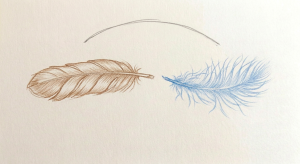
It is a commitment to joining myself to others—to friends, family, community—in love, belonging, and alignment. In choosing to remain intentionally vulnerable as I heal, I realized that the code remains unbroken.
énouement n.—the bittersweetness of having arrived here in the future, finally learning the answers to how things turned out, but being unable to tell your past self. It is derived from the French énouer, to pluck defective bits from a stretch of cloth + dénouement, the final part of a story, in which all the threads of the plot are drawn together and everything is explained. Pronounced “ey-noo-mahn.” (Koenig, 2021, p. 203)
I feel immense compassion for the confused little girl struggling to untangle her own rhythm from twinship choreography; for the young woman, wanting to be present and seen, receiving a literary education like a lifeline from her mother; and for the mature woman navigating the shifting currents of a life newly solitary—a life that is not what she imagined.
I understand now how my experimentation with vintage men’s fashion reflected my desire to be seen and known, transforming how I perceived myself. I realize now that the armor is not external. The true machinery is internal—an engineering of the spirit that can be re-engineered. I am deciding what to keep and what to let go. I am weaving a new design of personal sovereignty, built on self-awareness, mindful intention, values, self-respect, my distinct identity, integrity, and new purpose. Because that internal foundation is solidifying, the external can soften in my autonomous tempo.
I am no longer relying on a shared architecture to make me whole. I do not need the scaffolding of twinship, the high-stakes framework of a public career, or the expectations of a spouse, a parent, or a community to validate my existence. This does not mean I am choosing solitude as a permanent hiding place. Quite the contrary, I need friends, family, and community to love and to serve. But my fundamental wholeness is no longer dependent on an external chassis.
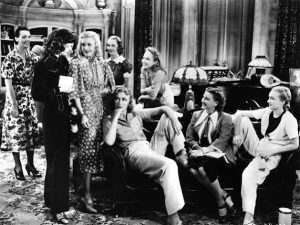
My wholeness is the internal architecture I have built between my individual self and my past—a resilience inside me that carries me into this present reality of still becoming. The dapper gentleman poet has not vanished from the narrative; she has actually retired into a more steadying calm, with the caps, code, and cadence to stay anchored in herself.
That precision that once demanded a perfectly aligned collar bar has simply realigned; it has moved inward. Today, that mindful engineering lives in the care with which I clean the tread of my hiking boots, the intentionality with which I reuse timber and stones to beautify my independent space, and the joyful ease with which I pair a simple T-shirt and a hoodie, or outfit myself in a kilt and festive accessories. By softening the lines, the style becomes an internal philosophy rather than an external shield.
This softening is not a surrender; it is a deliberate choice to care for what carries me now—this unhurried tempo, this hard-earned freedom, and a steady rhythm of care brought to a more peaceful life. It is a gentle-manliness that steps sure-footedly, holds an open heart, and claims its right to exist in the world—not in isolation. At the end of the day, the armor is gone, the cadence is steady, and I am just me. That is an elegance of a different sort.
Closing Note
A Gentleman’s Measure was not born on a screen, nor was its architecture assembled in a rush. It was built slowly, across many quiet mornings and evenings in neighborhood coffee shops, an espresso cocktail bar, and at home, using the scratch of ink on heavy paper and the soft friction of colored pencils.
For a long time, I believed that writing about the heavy machinery of my life required a dark, dense ink—a tobacco brown that matched the protective armor of my younger days. But as the movements slowed down and the lines began to soften into these casual cotton days, I noticed a change in the tools themselves. To look back at a complicated landscape with compassion—honoring the best of everyone while claiming my own right to fledge—requires a different kind of strength. It demands a willingness to let go of the shield and let the light back in.
There is a grounding comfort in realizing that the work of becoming is never fully finished; the nest simply moves where I move. And tonight, as I close this digital notebook and look down at my hands in the calm of my independent space, I have to smile at the precision of the universe. There is no heavy armor left to carry, but the labor of rewriting my story has left its mark. Stained lightly across the side of my thumb is a bright, unmistakable smudge of cornflower blue—a warm testament that curiosity and growth never retire, and that my fingers have finally caught up to one of my mother’s favorite dresses.
Final Notes: A Single Malt Perspective
- Appearance: Deep gold, un-chill-filtered, carrying the natural, resilient haze of a life fully lived.
- Nose: Peated coastal smoke, walnut trees, and worn leather, opening up to reveal the soft sweetness of riverbank earth, lavender silk, and summer cotton.
- Palate: A bold conversation of contrasts—the sharp discipline of an 1899 etiquette rule beautifully faced down by the rich, inherited code of a paisley bow tie, a 1938 graduation ring, and the shared precision of a ballroom dance.
- Finish: Exceptionally long, lingering, and unhurried. The sharp lines of the tailoring melt into an intentional softness. Lingers with a sense of hope, a reconciliation with the past, and a spirit comfortably settled into its own private weave.
A Sartorial and Symphonic Glossary
A note on text curation: The definitions below have been cut by hand and fitted exclusively to the contours of this essay. No need to tailor dictionary citations here.
Movement (noun / structure):
A self-contained narrative division within a larger symphonic composition, marking a distinct shift in emotional trajectory, landscape, and time. Rejecting rigid, linear chronology, a movement conceptualizes life like a bicycle wheel—where separate eras and milestones sit equidistant from the core of the self.
Caps (noun / discipline):
The physical and intentional mindfulness of wardrobe presentation as an act of self-possession. Historically a symbol of protective armor, the cap represents both boundaries and personal expression, giving a tangible texture to the daily choice of how we show up in the world.
Code (noun / lineage):
A standard of internal discipline, conduct, and preparedness inherited from ancestral lineage. Far from a rigid set of rules, it is a living philosophy of devotion—a commitment to the holy rituals of maintenance and care for things and people that carry you.
Cadence (noun / philosophy):
An internalized philosophy of structured weaving, steadying calm, and brave vulnerability. Derived from the Latin cadere (to fall), it is the steady, comforting beat of a life resolving on its own terms—serving as an unyielding internal handrail that anchors the self and supports one’s right to fledge.
Tempo (noun / mechanics):
The external, functional rate of speed at which an environment, relationship, or career moves. To master tempo is to choose mindfully when to change the momentum.
Rhythm (noun / architecture):
The physical, repetitive labor of movement and care that requires elements to run in alignment. It is the engine of a good fit—the structured discipline required to turn chaotic landscapes into a softer weave.
References:
- Smith, C., & Greig, C. (2003). Women in pants: Manly maidens, cowgirls, and other renegades. Harry N. Abrams. (It’s a remarkable book that powerfully contrasts rigid historical rules with the defiant spirits of the women who broke them.)
- Husband, S. (2016, April). Marlene Dietrich. The Rake, therake.com (The quote—a personal declaration—originates from Dietrich’s early life in Weimar-era Berlin during the 1920s. Before she became a global Hollywood icon, she frequently participated in the city’s vibrant drag balls, queer revues, and underground cabaret subculture.)
- Messy Nessy. (2017, May 22). Inside Le Monocle, the Parisian lesbian nightclub of the 1930s. Messy Nessy Chic. https://messynessychic.com (This article includes photographs shot by Brassaï (Gyula Halászin) 1932 in the dimly lit, smoke-filled interior of one of the most celebrated sapphic cabarets in France.)
- Fortescue-Brickdale, E. (Ed. and Illus.). (1919). Eleanor Fortesque Brickdale’s golden book of famous women. Hodder and Stoughton. (This book includes 16 tipped-in-color plates of original intricate artwork of women, both real and fictional, paired with historical texts from writers like Shakespeare, Keats, Tennyson, and Dickens. It is fascinating.)
- Oliver, N. (2009). A history of Scotland. Weidenfeld & Nicolson. Chapter 9: “This Land Is Our Land.” (This book is a good place to begin learning about Scotland’s history.)
- Carlile, B. “Returning to Myself (Sad Gay Version).” Genius, 2026, genius.com (It’s an emotionally vulnerable piece, reminding us that while returning to oneself is a lonely, necessary business, the final destination must always be a return to love.)
- Koenig, J. (2021). The dictionary of obscure sorrows. Simon & Schuster. (This book is a compendium of new words for emotions.)
Discover more from Forever Fledging
Subscribe to get the latest posts sent to your email.

Cheryl Kuck
Thank you for reading. Forever Fledging is a space for those who believe curiosity and growth have no retirement dates. Whether exploring everyday wonders or tackling heavy truths, let’s refuse to let our voices stay silent. Leave a thought below or subscribe to catch the next wind current.
View all posts by Cheryl Kuck