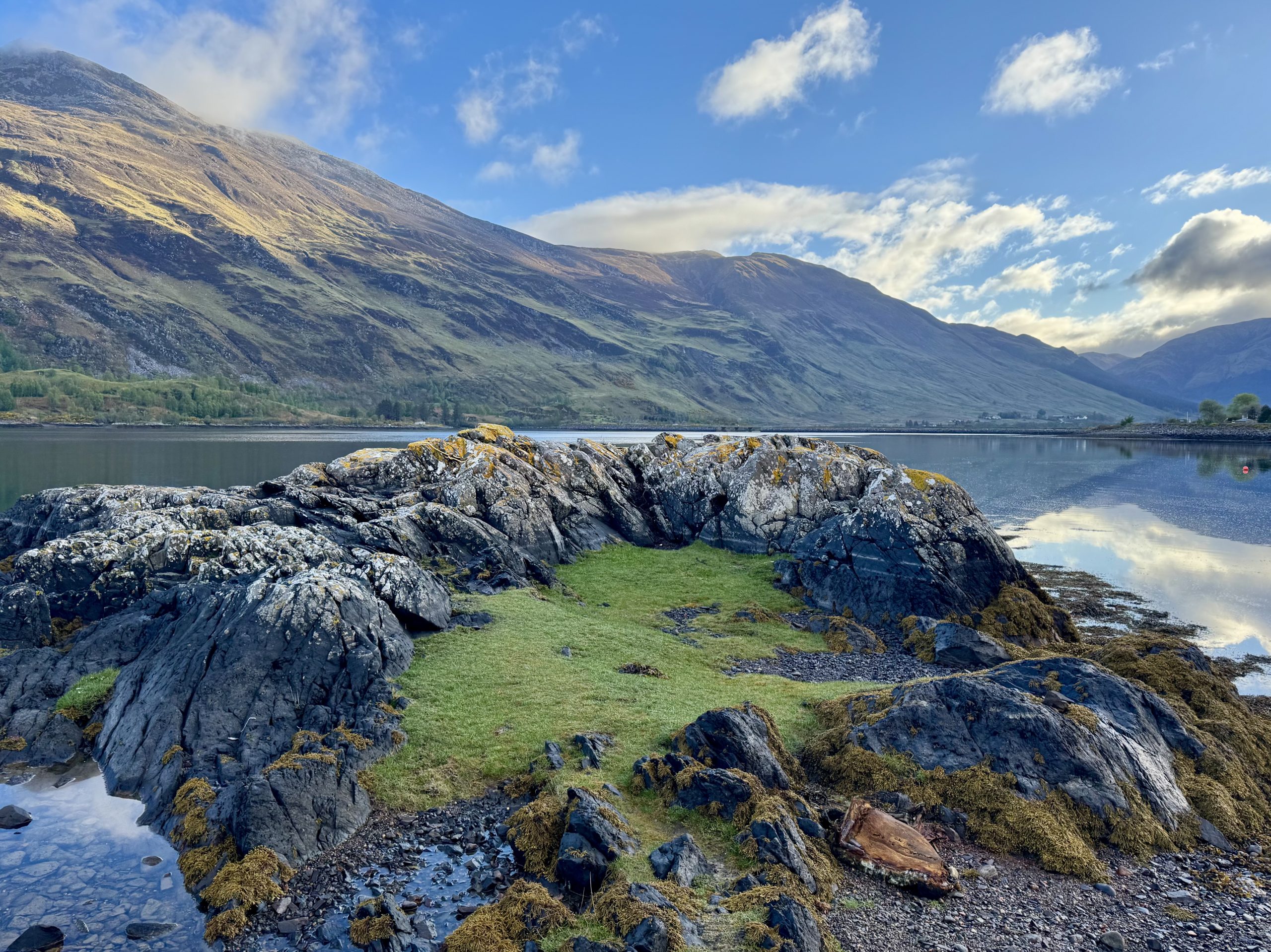

Coming home to Scotland gently soothes the lingering ache of cianalas as you step into the living, ancestral memory of dùthchas.
Coming Home
From the moment I arrived in Edinburgh in late April, Scotland welcomed me. The warmth and kindness of the people, the ancient majesty of the land, the awe of the castle rock, the unexpected encounters with wildlife, the haunting music, the must-try foods and drinks, and the centuries of spirited stories—it was as though Scotland knew I was coming and was glad of it. It felt as if the country had prepared a place for me and blessed me with an unmistakable faerie charm at every turn of the journey.
I would spend the next 16 days with friends and a Scotland Folk Tours group (scotlandfolktours.com) touring Edinburgh and the Scottish Lowlands, Highlands, and Isles in a presence that felt like coming home. There are two Scottish Gaelic words that describe this phenomenon: cianalas (KEE-un-uh-luss) and dùthchas (DOO-khus):
- Cianalas describes the deep, bittersweet ache or longing for one’s ancestral homeland.
- Dùthchas describes the inherent, unbreakable bond between a person, their ancestors, and the land.
Both of these words describe a “birthright belonging” and a connection to a landscape that is carried in our blood. Although our families left Scotland more than a century ago, we feel an unexplained, visceral pull when we first stand on Scottish soil, a feeling of coming home to a place we have never been. This blood memory is as if the body and the blood physically remember the landscape.

On my last evening in Scotland, I stepped into Europa Music, a record shop located at 10 Friars Street in Stirling. Hoping to find a CD of traditional Scottish music, I had an engaging experience with the shop owner. Outstanding in his knowledge and hospitality, Hamish foraged through his impressive collection of CDs and vinyl. With quiet satisfaction and a warm smile, he presented to me The Music & Song of Greentrax, a 10th-anniversary double album of Scottish music released by Greentrax Recordings.
Hamish and I talked about music, politics, his home in Scotland, and my home in Oregon. When it was time for me to leave the shop, Hamish said to me sincerely, “Haste ye back.” When it was time for me to leave Scotland, the land itself seemed to whisper that classic Scottish farewell.
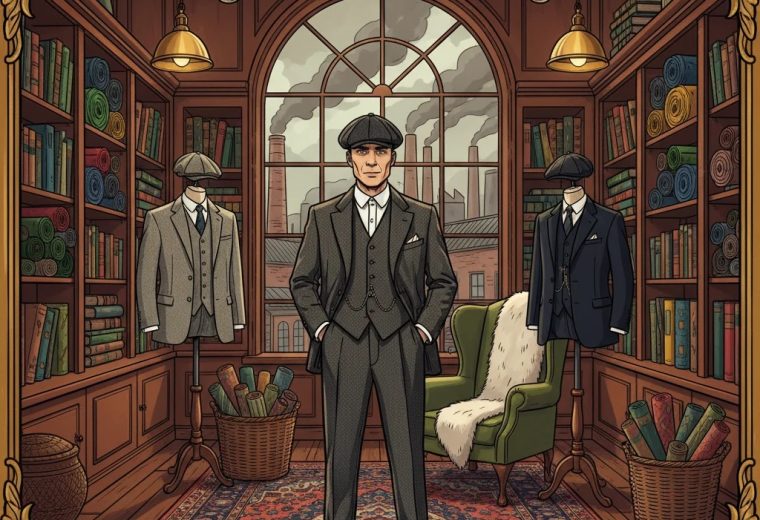
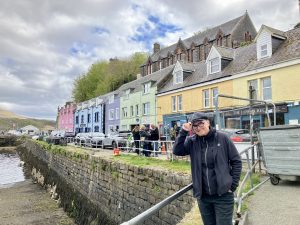
Returning home to Portland, I couldn’t leave the magic of Scotland behind. It stayed with me—in my memories, my daily reflections, the books I read, the music I played, the pubs I visited, the tea and whisky I tasted, the sliced cobblestones I carried in my pocket, the Harris Tweed baker boy cap I wore every day, the stories I shared, and the new friendships I made. Scotland still called to me. Looking at photos on a screen wasn’t enough. I wanted to carry the magic with me always, letting Scotland become a permanent part of who I am.
Tattoos…are the stories in your heart, written on your skin. —Charles de Lint, The Mystery of Grace
That’s it, I thought! How do I tell the story of my Scotland trip on my skin? I picked up a pencil and began to draw.
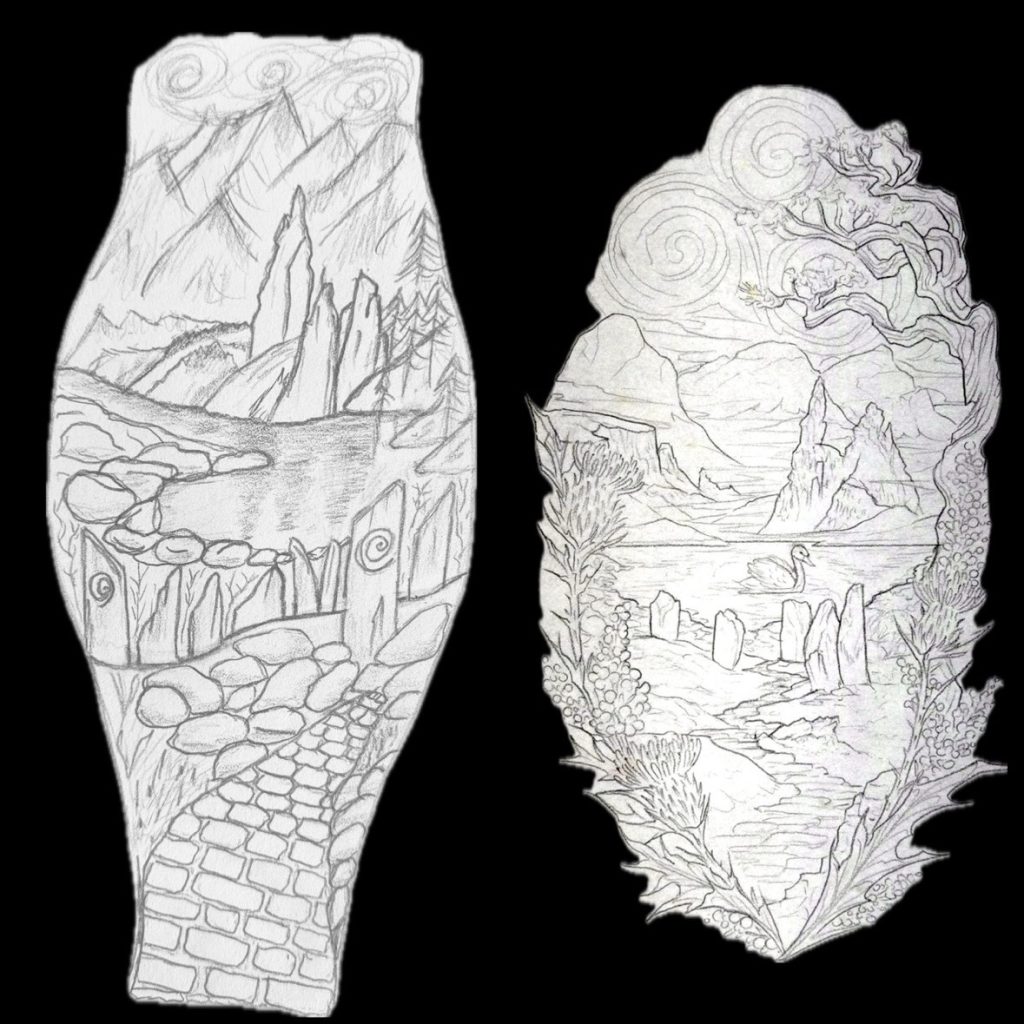
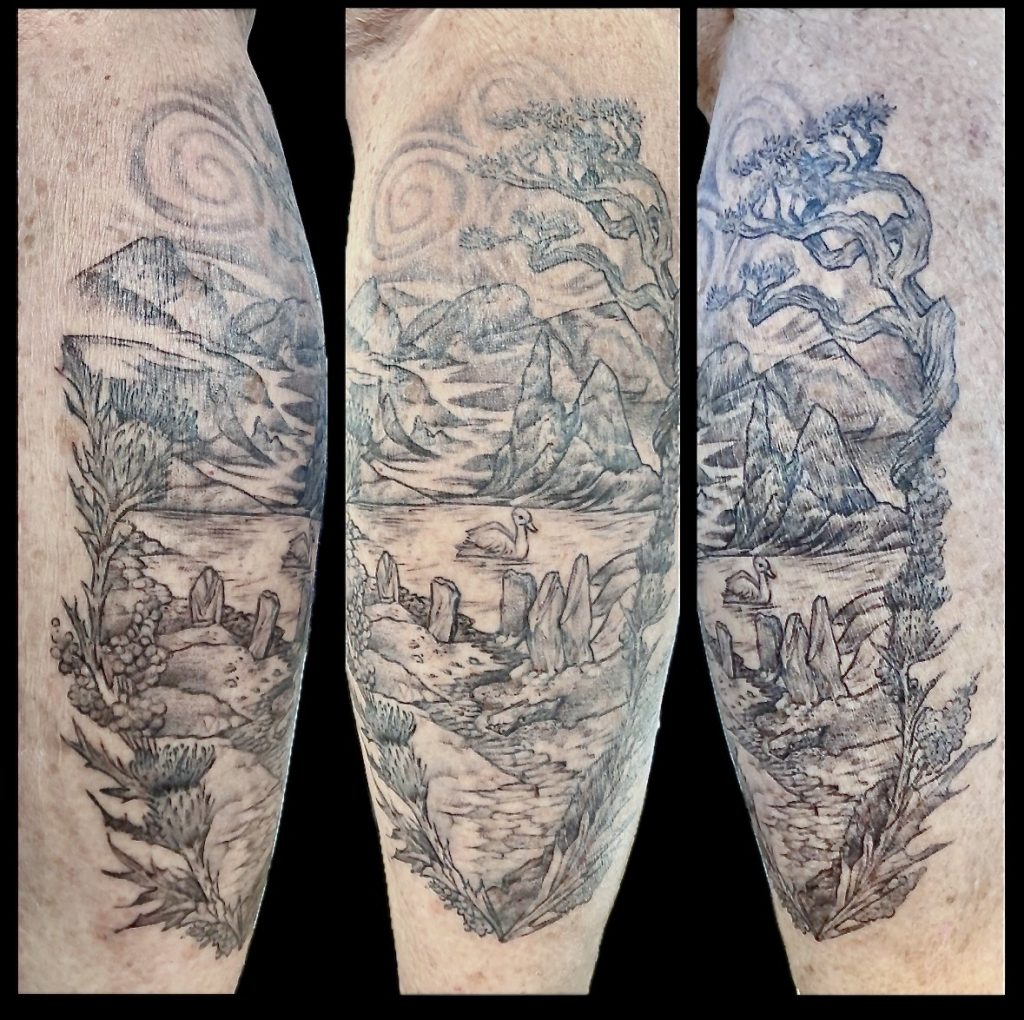
To bring my personal vision to life, I collaborated with artist Shauna Seligman (decoartsclub.com) at Infinity Tattoo in North Portland. I brought her my sketch and shared my story. For 45 minutes, we talked about Scotland, the tattoo concept, her background, and a fun inquiry to help with design choices. At her request, I emailed her photos from my trip. She then used her incredible artistry to actualize my vision as a six-hour, black and grey realism, calf piece.
Design Collaboration: A Vertical Journey
Whereas my concept sketch stacks the various landscapes I wanted to include, Shauna’s design layout mimics a physical journey. Her design provides perspective that invites me into the landscape and plants my feet at the base to begin the journey from lowest to highest elevations. She turned my rough ideas into absolute magic.
The tattoo flows seamlessly up my calf, transitioning from humanmade history of the cobblestones above my ankle to natural earthiness of the lowlands, ancient mysticism of the standing stones, peace and eeriness of the highlands, raw primordial nature of the Isle of Skye, majestic mountains of Glen Coe, and finally, to eternity of the sky just below my knee.
When I step into the tattoo landscape and journey up its layout on my leg, I am back in Scotland. This is what I see and remember:
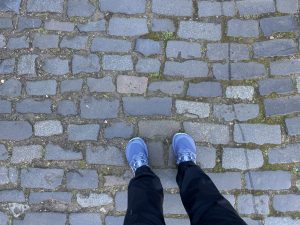
- Base (humanmade history): The journey begins at the base of my leg in Edinburgh, on an ancient cobblestone path bordered by sprigs of heather and thorny thistle. A section of Edinburgh Castle grounds the piece in Scotland’s urban history. Every moonlit night, I walk Princes Street to see the Castle glowing on its volcanic crag like a crown. Leaving the stone-carved streets of the city and its castle behind, I walk to historic Dean Village and slip onto the Water of Leith Walkway, a tranquil riverbank where the modern world dissolves entirely.
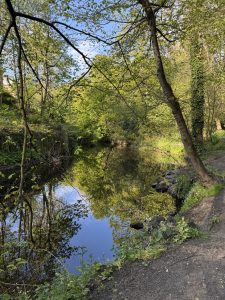
Water of Leith Walkway, Dean Village, Edinburgh, Scotland. - Lower Calf (natural lowlands and mysticism): Moving upward, the path fades into a mossy, peaty, untamed landscape. Tucked into this natural terrain are the rugged, cracked standing stones of Clava Cairns, etched with Celtic Picts symbols. This peaceful site, just outside Inverness, is the real-world inspiration for Craigh na Dun, the mythical split stone circle that transports Claire back in time in the Outlander TV series. I gently place the palms of my hands on an ancient megalith, close my eyes, and wait for the wind to shift or time to slip. Every day in Scotland feels like time traveling.
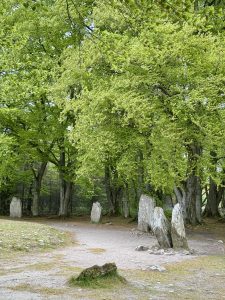
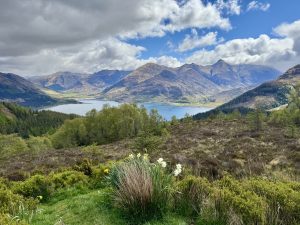
Standing stones at Clava Cairns, near Inverness, Scotland. - Mid-Calf (transition to highlands): The landscape then opens up into the calm, deep waters of a loch, where a solitary mute swan glides across the glassy surface. Cradled inside a glacial valley and mythical faerie glen, the saltwater mirrors the surrounding mountains and volatile skies. One of my favorite memories is rock hunting along the edge of Loch Duich at low tide, where the historic Kintail Lodge clings to the shore. Every morning, I walk around the loch, sinking my feet into the merse and swards as I climb what I fondly call “my mini-Munro.” Stunning views of the Glen Shiel Ridges change colors as sunlight filters through the clouds.
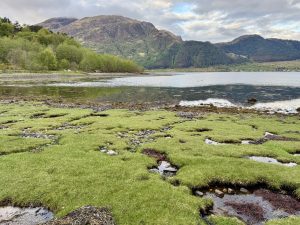
Loch Duich coastal saltmarsh (merse) with its tidal channels, dense and springy grassy mats (swards), peat, and mud. 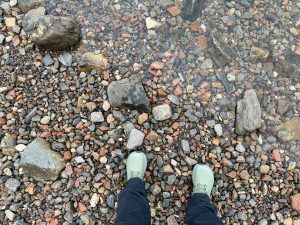
A mix of metamorphic rocks, formed 3 billion years ago, on the shore of Loch Duich. - Upper Mid-Calf (primordial nature): Above the water, the atmosphere becomes dreamlike and timeless with a journey to the Isle of Skye. The wild hillsides, rock formations, plateaus, and valleys of The Quiraing frame my inner calf, and the sharp, towering pinnacle of The Old Man of Storr climbs up my leg like a ghost. Local folklore says the prominent basalt pinnacle is the buried thumb of a giant. Walking on a dirt path, I descend into a deep hollow, hidden in the rock labyrinth of The Quiraing, and feel swallowed up. Completely alone and in silence, I enjoy my sack lunch of Scottish smoked salmon and cream cheese on a bagel.
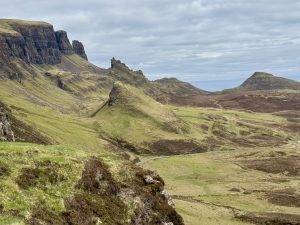
The Quiraing on Trotternish Peninsula of the Isle of Skye, Scotland. 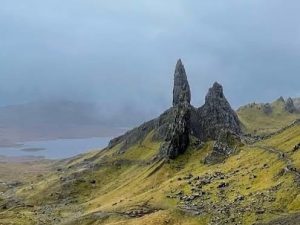
The Old Man of Storr basalt rock pinnacle on the Isle of Skye, Scotland. - Upper Calf (highland mountains): The basalt pinnacles lead into the massive Three Sisters of Glen Coe. Like ancient sentinels standing shoulder to shoulder, they guard the pass with somber dignity while fingers of highland fog roll over them. On my footpath stroll through the wooded glen at Glencoe National Nature Reserve, I step back in time. I remember the stories of Clan MacDonald, spy Ossian’s Cave in the distance, and get a feel for 17th-century life when I step into the re-imagined turf and creel house at the foot of Meall Mòr. The soaring cliffs of the Three Sisters are in firm view through the sweeping, U-shaped glen.
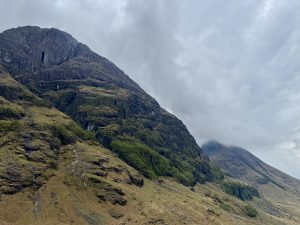
Ossian’s Cave, a natural, keyhole-shaped rock cleft high on the face of Aonach Dubh (one of The Three Sisters), Glen Coe, Scotland. 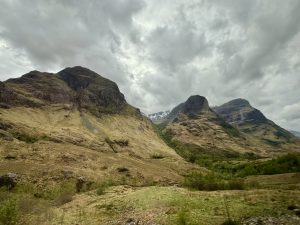
The Three Sisters of Glen Coe, Scotland. - Knee (sky and eternity): The piece finishes just below my knee, fading out into a moody, foggy, and windy sky, complete with a whimsical Celtic triskelion that fades at the edges like mist—a perfect nod to Scotland’s volatile, ever-changing sky.
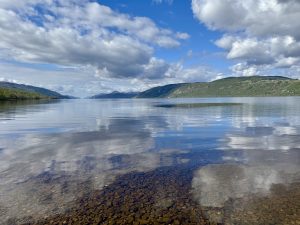
Loch Ness in the Scottish Highlands, home of the legendary Nessie. - Frame: The framing of the tattoo was all Shauna’s idea. She incorporated Scottish heather and thistle, rooted above my ankle, branching outward and upward, as though peeling back my skin to reveal the story and landscape within. A gnarly, ancient Caledonian Pine tree frames the outside of my calf, adding perspective and a sense of deep time to the landscape.
Personal Treasures in the Terrain
What makes this piece even more special are the specific details I asked Shauna to integrate into the landscape, if possible, to capture the texture and magic of my trip.
- Mute Swan: A solitary swan swims across the loch, representing the hundred or so swans I saw on St. Margaret’s Loch, Linlithgow Loch, and Oban Bay. Because Swan is my spirit creature, their presence made me feel included and connected to their wildness. In Scottish folklore, swans are revered as sacred, Otherworldly shapeshifters.
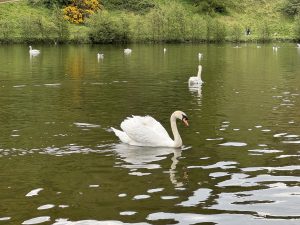
Mute Swans on St. Margaret’s Loch, Edinburgh, Scotland. - Hidden Heart Rock: Discreetly hidden among the fractured bedrock is a rock shaped like a heart—a personal nod to my love for heart-shaped rocks and the ones I collected and brought home from Scotland. Can you find it?
- Caledonian Pine Tree: I wanted a Caledonian Pine tree as a living link to Scotland’s prehistoric past. Our tour guides explained how the destruction of the highland forests drove iconic species like lynx, wolf, and brown bear to extinction in Scotland. On the West Highland Line train between Glasgow and Oban, I was fortunate to see surviving pockets of these old-growth trees. As the train snaked past Dalmally Station and the long shores of Loch Awe, I spotted Red Deer. Half-hidden in the heather and wooded glen, they grazed in the grasses and shrubs.
- Celtic Symbols: I wanted a Celtic or Scottish Picts symbol somewhere in the tattoo. Shauna beautifully used a Celtic triskelion design to represent the ever-changing Scotland sky. The triskelion celebrates the magic of three: past, present, future; land, sea, sky; mind, body, spirit; action, progress, completion.
Shifting Landscapes: The 6-Hour Grind
After the initial consultation, my tattoo required two appointments. Initially, I anticipated the second session to be a final pass for added details. However, I learned that professional black and grey realism relies on a strategic, multi-layered, chemical and visual timeline to prevent fine line details from becoming muddy or blurred. I had never had a tattoo that involved multiple sessions, so it was fascinating to learn more about the science of tattooing.
Session 1: The Four-Hour Architectural Blueprint
During the first session, Shauna set up the station for our mutual comfort, reviewed the process and what to expect, created and applied her tattoo stencil to my calf, and then did four solid hours of tattooing with me lying flat on my stomach. We took two short breaks for bathroom trips, water, snacks, and stretching.
- Hour 1: Alignment and Fine Lines: I stood as Shauna placed the large stencil on my calf so that it flowed naturally with the musculature of my lower leg. Then I lay down on the tattoo table, and she began the foundational work. Using specialized fine-line needle groupings, she mapped out the structural framework of the cobblestones, heather, and thistle. Pain level: I felt the sting of the needle, but it was not uncomfortable. Due to the rush of adrenaline and endorphins, it was oddly satisfying.
- Hours 2–3: Mapping the Mid-Tones: This phase focused on building the expansive landscape up my calf. Shauna laid down soft gray washes (mid-tones) across the rocks, standing stones, pinnacles, pine tree, swan, and loch. Pain level: When the needle hit certain spots packed with nerve endings, my leg twitched involuntarily. My inner calf was sensitive, feeling like a cross cat scratching my skin—irritating but tolerable.
- Hour 4: Soft Mountains and Atmospheres: Shauna focused on the mountain textures, dark volcanic rock faces, and the top of the pine tree, applying delicate mid-tone gray washes to simulate an ethereal, foggy look. Pain level: The sharp stinging increased during the last 15 minutes. The sensation was like sandpaper passing over a bad sunburn. It was time to stop.
Shauna applied a non-stick, absorbent cotton pad covered with a thin, perforated plastic film layer—a bandage to absorb plasma and excess ink without sticking to the tattoo. Then she wrapped it with a self-clinging, stretchy medical wrap. I kept the bandage on for 24 hours, removed it, and followed Shauna’s instructions for daily tattoo after-care.
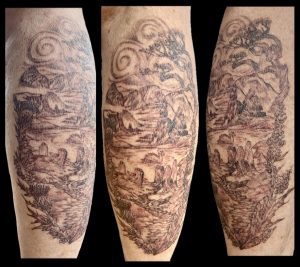
When I looked at my leg over the following weeks, I noticed the healed tattoo looked lighter, softer, and more muted than I had expected. I came to learn this was completely intentional. By restricting the first four hours to fine lines and mid-tone washes, Shauna avoided over-traumatizing my skin, leaving the deep layers healed, stable, and ready to accept more contrast without scarring.
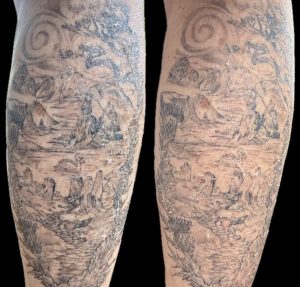
Session 2: The Two-Hour Dimension Injection
Because calf tattoos take longer to regenerate due to lower leg circulation, we pushed the second session out a full five weeks later to allow my skin to completely peel and reset. The final two hours were focused on bringing the piece to life through depth, contrast, and highlight values.
- Hours 5–6: Saturated Darks and Luminous Lights: This session wasn’t a touch-up; it was a masterclass in physics and dimension of black and grey realism tattooing. Shauna packed rich, dynamic blacks into the deepest recesses—outlining the standing stones, grassy plateau, pinnacles, and mountains; engraving the cracks in the stones; carving out the shadows of craggy bedrock; and defining the dark volcanic rock faces. This black ink placement pushed the healed, five-week-old mid-tones forward, creating a striking three-dimensional window effect. Finally, Shauna applied light gray shading to hit the highest points of the mountains and sky, giving the clouds a sense of mist and movement. Pain level: Working over previously tattooed territory was sharp, but the short two-hour window made it highly manageable as my brain released a final wave of adrenaline.
Because my skin was not as irritated as it was after the first tattoo session, Shauna applied a Saniderm bandage, which is a transparent adhesive film that is breathable and waterproof. It locked in the natural healing fluids, prevented scabbing, and protected my fresh tattoo against bacteria. I kept it on for four days, peeled it off gently under warm running water, and followed a daily routine for tattoo after-care.
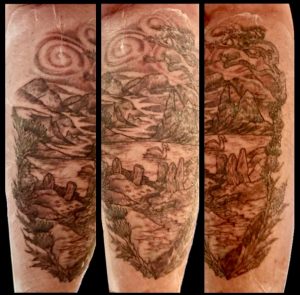
Seeing my personal journey, photography, and original concept blended into a cohesive, meaningful story on my skin was worth every single second of the tattoo process. The discomfort was quite manageable, and the process was exciting, rewarding, and enjoyable.
A Gentle Warning to Readers: The Reality of Calf Ink
While the final product is a walking art gallery, getting a large realism piece on your lower leg is a serious physical test. Online tattoo pain charts give you an idea of what to expect from your ankle on up to the back of your knee, but every person’s body is different, every person’s tolerance is different, and every tattoo artist is different. For me, my skin is dry and sun-damaged, my pain tolerance is high, and Shauna is a veteran tattoo artist with 20 years of experience. Plus, her needle work is gentle and fast!
If you plan to tackle a calf ink like this, prepare yourself for two potential hurdles:
- Involuntary Leg Twitches: The calf is packed with nerve endings. No matter how strong your willpower is, your leg will jump and twitch on its own when the needle hits certain spots. Tattoo artists like Shauna are used to this. Don’t fight your own reflexes; just give into the twitching. It will happen regardless of how much you try to will it away.
- The “Tattoo Flu”: Sinking heavy ink into a large area for hours sends your immune system into overdrive. By the time I got home after the first session (4 hours of tattooing), I hit a wall of fatigue. The next morning, I had body aches and mild nausea. It felt like the flu, but it was not a viral infection. It was just my body reacting to intense trauma to the largest organ of the human body, the skin. I felt fine the next day, and I felt fine after the second session (2 hours of tattooing).
Healing a calf tattoo takes patience. Hydrate and eat a big meal beforehand. Rest after your session, elevate your leg, hydrate, and clear your schedule for two days. Listen to your artist. Follow their instructions for after-care. And listen to your body.
It’s In My DNA
Just as I felt a sense of coming home when I set foot on Scottish soil last April, I felt a similar memory while I was getting my tattoo. As the needles pricked my skin, I could tell what section of the landscape Shauna was tattooing. I had a physical, cellular feeling of recognition as she marked my skin with landscapes that are part of my ancestral DNA. It was the realization that we do not just look at a landscape, but that the land and our lineage are permanently etched inside us. That is the essence of dùthchas.
Long after the flight home from Scotland, this ink will serve as a permanent window back to the places, people, wildlife, and stories that captured my heart and blessed my whole being. I still feel Scotland in my soul. I want to go back. It is a beautiful longing for a home across the sea that constantly pulls at my spirit. That is the essence of cianalas.
There is a beautiful irony in how this journey began. I sought a tattoo to make Scotland a permanent part of who I am, only to realize it was already woven into my blood, body, and soul long before I ever crossed the sea.
Thank you for reading. Haste ye back! Here’s a parting song written by Robert Wilson, titled “Haste Ye Back”:
Haste ye back, we loo you dearly
Call again, you’re welcome here.
May your days be free from sorrow,
And your friends be ever near.

May the path on which you wander
Be to you a joy each day.
Haste ye back, we loo you dearly
Haste ye back on friendship’s way.
Notes
- Scotland Folk Tours offers small-group, guided tours of Scotland that combine local storytelling, live traditional music, and authentic food with expert guides who share the history and culture of the land they obviously love. Their official website is scotlandfolktours.com.
- Scottish Gaelic Concepts. To hear the pronunciation of these untranslatable words, use the official LearnGaelic Dictionary. To explore the cultural depth behind cianalas (ancestral longing), read the essay “Cianalas: The Gaelic ‘Homesickness'” on the travel and culture blog Stories My Suitcase Could Tell. To understand the profound human-ecological relationship of dùthchas (the bond to ancestral land), watch the video lecture “Dùthchas: Deepest Word in Scottish Gaelic?” on YouTube.
- Scottish Music CD. Various Artists. (1996). The music & song of Greentrax (The best of Scottish music). Greentrax.
- Harris Tweed is a legally protected, handwoven woolen cloth produced exclusively by islanders in their homes across the Outer Hebrides of Scotland (Lewis, Harris, Uist, Barra) from pure virgin wool dyed and spun on the islands (Harris Tweed Act 1993).
- The Charles de Lint tattoo quote is spoken by the character Conchita in de Lint’s novel The Mystery of Grace (2009, p. 12), which explores themes of magic, love, and faith in a fictional Southwestern town.
- Shauna Seligman has been a professional tattoo artist since 2006 and currently works at Infinity Tattoo in Portland, Oregon. Her professional portfolio, personal bio, and booking forms are available on her personal website decoartsclub.com and on her professional Instagram page @decoartsclub.
- The Picts were a fierce tribal people of matrilineal lineage who lived in Scotland north of the Firth of Forth from around AD 300 to AD 900. Interestingly, my choice to commemorate my Scotland homecoming with a tattoo echoes Scotland’s ancient history. The Romans named the indigenous people of Scotland the Picts or Picti (meaning “the painted ones” or “the people of the designs”) because they heavily marked their skin with symbols tied to the nature and land around them. Learn more in Neil Oliver’s A History of Scotland (2009, p. 43).
- Rabbie’s Outlander Tour. My traveling companions and I are all fans of the Outlander television show. We spent our second day in Scotland on The Outlander Adventure, a one-day tour conducted by Rabbie’s. It features best-known film locations featured in the series: Midhope Castle (Lallybroch, Jamie Fraser’s home), Blackness Castle (Fort William, headquarters of Jack Randall), Linlithgow Palace (Wentworth Prison, where Jamie is held and tortured), Culross (Cranesmuir, home of Geillis Duncan and Claire Fraser’s herb garden), and Doune Castle (Castle Leoch, home of Colum MacKenzie). Learn more at rabbies.com.
- A Munro is a mountain in Scotland that stands over 3,000 feet, named after Sir Hugh Munro, who first catalogued them in 1891. The official list features 282 peaks across the Highlands, Isles, and Lowlands. Climbing them, known as Munro bagging, is a popular Scottish hillwalking pastime.
- Swans. In Scottish folklore, swans are magical and liminal, symbolizing the soul, deep transformation, and a link to the mystical Otherworld. Unlike the malice and danger symbolized by the Highland Kelpies, swans symbolize gentleness and peace. Swan’s place on the Oglala Sioux Lakota Medicine Wheel is in the north. Swan symbolizes grace, intuition, determination, and inner transformation. In both cultures, swans fly into the spiritual realm and return to the physical world with healing knowledge.
Share Your Journey!
Have you ever been changed by a travel experience? Did a country ever feel like it was welcoming you home? I would love to hear your stories. Drop a comment below and share your favorite memories of Scotland, or link a photo of your own meaningful travel tattoos.
Composed between August 2 and September 30, 2026. It documents the entire journey of conceptualizing my tattoo, finding my artist, collaborating on the layout, reviewing the final drawing, getting inked, and the healing process. All photographs were captured by the author, Cheryl Kuck, during a trip to Scotland from April 25 to May 13, 2025.
Discover more from Forever Fledging
Subscribe to get the latest posts sent to your email.

Cheryl Kuck
Thank you for reading. Forever Fledging is a space for those who believe curiosity and growth have no retirement dates. Whether exploring everyday wonders or tackling heavy truths, let’s refuse to let our voices stay silent. Leave a thought below or subscribe to catch the next wind current.
View all posts by Cheryl Kuck